Kitchen appliances tend to fall into two categories: the ones that get used once and then buried in a cabinet, and the ones that earn a permanent spot on the counter. Air fryers, as a category, have mostly landed in the second group over the past several years, and compact models like the Chefman 4 QT Air Fryer are part of the reason why. This article takes a closer look at what this particular appliance offers, how it fits into different kitchen routines, and what shoppers should think about before adding one to their home.
This is an informational overview, not a personal review. The goal is to walk through the product’s features, practical applications, and considerations in a way that helps you decide whether it aligns with your cooking habits and space requirements.
Introduction
Compact air fryers occupy a specific niche in the kitchen appliance world. They’re designed for people who want the convenience of air frying without dedicating a large footprint of counter or storage space to it. The Chefman 4 QT Air Fryer fits squarely into this category, positioning itself as a smaller-capacity option built around simplicity, visibility, and ease of cleaning.
Air frying itself works by circulating hot air rapidly around food, which creates a crisp exterior similar to deep frying but typically with far less oil. This method has become popular among people looking to prepare fried-style foods — think french fries, chicken wings, or roasted vegetables — with a lighter approach. The Chefman model brings this cooking method into a smaller unit, aimed at singles, couples, small families, or anyone with limited kitchen real estate.
Below, we’ll break down what this air fryer includes, how people generally use appliances like it, who tends to benefit most from a compact design, and what to keep in mind before purchasing.
Key Features
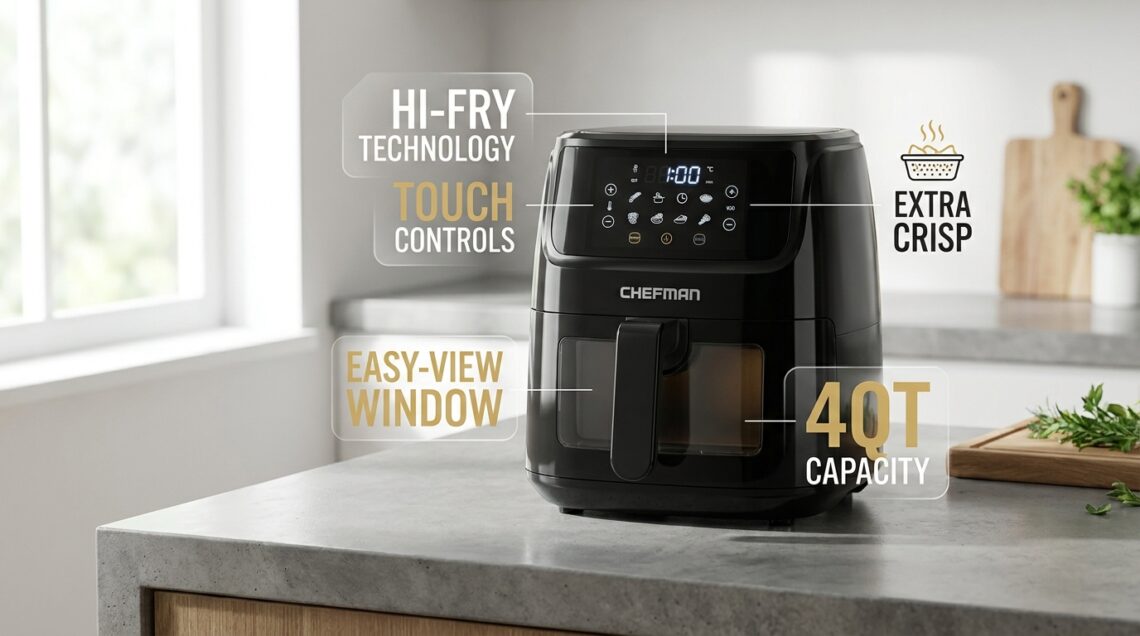
Hi-Fry Technology
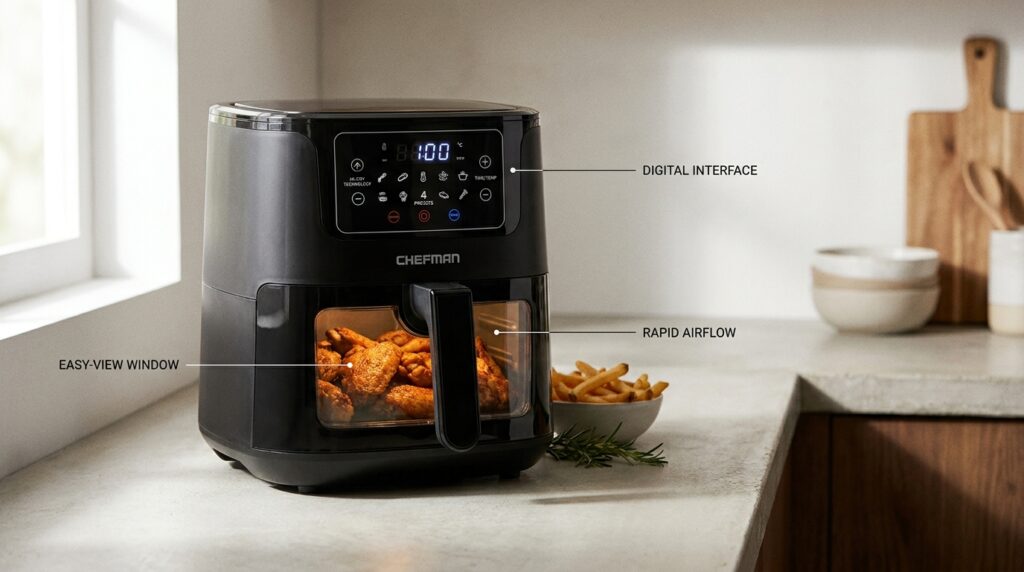
One of the more notable aspects of this model is what Chefman refers to as “Hi-Fry Technology.” This generally refers to a heating and air circulation system designed to promote even crisping across the surface of food. In practical terms, this kind of technology aims to reduce the need for flipping or shaking food halfway through cooking, since the goal is consistent heat distribution throughout the basket. For anyone who has used a lower-quality air fryer and ended up with unevenly cooked fries — crispy on one side, soft on the other — this type of feature is meant to address that common frustration.
4-Quart Capacity
The 4 QT size places this unit in the compact-to-mid-size range of air fryers. It’s larger than the smallest 2-quart personal models but noticeably more space-efficient than the 8-quart-plus family-size fryers that have become common in recent years. This capacity is generally suited to preparing single servings, side dishes, or meals for one to three people, depending on what’s being cooked and how it’s portioned.
Easy-View Window
A transparent viewing window built into the unit allows you to monitor food as it cooks without opening the basket. This matters more than it might initially seem. Every time an air fryer basket is opened mid-cycle, hot air escapes and cooking time is disrupted, which can affect texture and consistency. A viewing window lets you visually check on browning or crisping progress without interrupting the cooking cycle, which is a small but genuinely useful convenience for anyone learning how their particular fryer behaves with different foods.
Touch Controls with Presets
The unit includes a touch-based control panel with four preset cooking functions. Presets are designed to simplify the cooking process by removing the guesswork around temperature and time for common foods. Instead of manually researching and inputting settings for something like frozen fries or chicken tenders, a preset button applies settings that are generally calibrated for that type of food. This is particularly helpful for people newer to air frying who aren’t yet familiar with how different foods respond to different heat levels and durations.
Touch controls, as opposed to mechanical dials, also tend to offer a cleaner, more modern aesthetic and can be easier to wipe down during cleaning, since there are fewer physical crevices for grease or crumbs to collect in.
Nonstick, Dishwasher-Safe Basket
The cooking basket features a nonstick coating, which serves two main purposes: it helps food release cleanly after cooking, and it reduces the amount of oil needed during the cooking process itself. The basket being dishwasher safe is a practical detail that shouldn’t be overlooked — hand-washing sticky, grease-coated baskets is one of the more tedious parts of air fryer ownership, and having a dishwasher-compatible component can meaningfully reduce daily maintenance effort.
Compact Black Design
The unit’s black finish and relatively small footprint are intended to blend into a variety of kitchen aesthetics without demanding much visual or physical space. For kitchens with limited counter real estate, this sizing consideration can be just as important as the appliance’s cooking performance.
How It Can Be Used
Air fryers of this size and style tend to be versatile in the kitchen, even with a smaller capacity. Here are some general use cases people commonly associate with compact air fryers like this one:
Quick weekday meals. For people cooking for one or two, a 4-quart air fryer can often handle an entire meal component — a protein, a side of vegetables, or a starch — without needing multiple cooking vessels or a full oven preheat cycle.
Reheating leftovers. Air fryers have become a popular alternative to microwaves for reheating certain foods, particularly anything that benefits from re-crisping, like pizza, fried chicken, or roasted potatoes. Unlike a microwave, which tends to leave food soft or soggy, air frying can restore some of the original texture.
Frozen food preparation. Items like frozen fries, mozzarella sticks, chicken nuggets, and similar convenience foods are commonly cooked in air fryers as an alternative to using a full-size oven, especially when only a small portion is needed.
Light roasting. Vegetables like broccoli, Brussels sprouts, carrots, and cauliflower can be roasted in an air fryer with a small amount of oil, often in less time than a conventional oven would require.
Reduced-oil cooking. For those trying to cut back on oil in their cooking without eliminating fried-style textures altogether, air frying offers a middle ground. It won’t replicate deep frying exactly, but it can approximate the texture with a fraction of the oil.
It’s worth noting that with a 4-quart capacity, batch cooking for larger groups may require cooking in multiple rounds rather than all at once, which is an important practical distinction from larger-capacity models.
Who It May Be Suitable For
Compact air fryers like this one tend to appeal to a fairly specific set of households and lifestyles:
- Individuals living alone or in small households who don’t need to cook large quantities at once and prioritize convenience over batch capacity.
- Couples or small families who can accommodate slightly smaller portion sizes or don’t mind cooking in two rounds occasionally.
- People with limited kitchen counter space, such as those in apartments, dorm-style living, or smaller homes where a bulky appliance isn’t practical.
- First-time air fryer users who want to try the cooking method without committing to a large, more expensive unit right away.
- Anyone looking for a secondary or supplemental cooking appliance, rather than a full replacement for an oven, for tasks like reheating or quick sides.
On the other hand, larger families, people who frequently cook in bulk, or those who meal prep for the week in large batches may find a 4-quart capacity limiting and might want to consider a larger unit instead.
Important Things to Consider
Before purchasing any air fryer, compact or otherwise, there are a few practical factors worth thinking through:
Capacity versus household size. It’s worth being realistic about how much food you typically cook at once. A 4-quart basket is generally best suited to smaller portions, and cramming too much food in at once can actually hinder the air circulation that makes air frying effective in the first place, leading to uneven results.
Counter and storage space. Even compact air fryers take up a noticeable footprint, and many are not particularly lightweight or easy to store away between uses. It helps to measure your available space beforehand, including clearance for ventilation, since air fryers typically need airflow around the unit to function properly and avoid overheating.
Preset limitations. While presets are convenient, they aren’t infinitely customizable. If your cooking style involves a lot of experimentation with different foods, you may find yourself using manual settings more often than the four built-in presets.
Cleaning routine. Even with a dishwasher-safe basket, other components of the unit — including the heating element and outer housing — typically need to be wiped down by hand. Regular cleaning is important not just for hygiene but for maintaining consistent cooking performance over time, since grease buildup can affect airflow.
Warranty and customer support. As with any small appliance, it’s worth checking the manufacturer’s warranty terms and understanding what kind of support is available in case of defects or malfunctions.
Noise and operation. Air fryers, by nature of using a fan to circulate hot air, do produce some operational noise. This is generally comparable to a small kitchen exhaust fan, but it’s a detail some buyers appreciate knowing in advance.
Comparing General Categories of Air Fryers
Rather than comparing specific competing products, it can be more helpful to understand how compact air fryers generally differ from other categories on the market:
Compact air fryers (2–4 quarts): These prioritize space efficiency and are typically aimed at individuals or small households. They tend to have simpler control panels and fewer built-in accessories, focusing on core functionality.
Mid-size air fryers (5–6 quarts): These offer more cooking capacity, suitable for families of three to four, while still maintaining a relatively manageable footprint. They often include a broader range of presets or cooking modes.
Large or family-size air fryers (7 quarts and above): Designed for bigger households or those who frequently batch cook, these units take up significantly more space and are often heavier, but allow for cooking larger quantities in a single cycle.
Air fryer ovens/toaster-style units: These use a different form factor entirely — typically a horizontal, oven-style design with racks — offering more versatility (baking, toasting, rotisserie functions) at the cost of a considerably larger counter footprint.
Understanding where a product like the Chefman 4 QT falls within this spectrum can help clarify whether it matches your actual cooking needs, rather than evaluating it in isolation.
Frequently Asked Questions
Does a 4-quart air fryer work for meal prepping? It can, though portion sizes and batch quantities will be more limited compared to larger units. Meal prepping for one or two people is generally more manageable than prepping for a larger household in a single cooking cycle.
How does Hi-Fry Technology differ from standard air frying? While specific technical details vary by manufacturer, features like this are generally designed to improve heat distribution and reduce the need for manual flipping or shaking during the cooking process, aiming for more even crisping.
Is the nonstick basket coating durable over time? Nonstick coatings on any cooking appliance can wear down with heavy use, particularly if metal utensils are used inside the basket. Using silicone or wooden utensils, and avoiding abrasive scrubbing, generally helps preserve the coating longer.
Can this air fryer replace a conventional oven? For smaller portions and quicker cooking tasks, many people use air fryers as a substitute for oven use, particularly to avoid heating up a large oven for small meals. However, for large batches, multi-rack baking, or certain recipes requiring more space, a conventional oven still tends to be more practical.
Are touch controls harder to use than dial controls? This tends to come down to personal preference. Touch controls generally offer a sleeker design and easier cleaning, while dial controls can feel more tactile and straightforward, especially for users less comfortable with digital interfaces.
Is preheating necessary? Preheating recommendations vary depending on what’s being cooked. Many air fryer recipes are designed with preheating in mind, so checking specific recipe guidance is generally more reliable than assuming a universal rule.
Conclusion
The Chefman 4 QT Compact Air Fryer represents a fairly typical, well-rounded entry into the compact air fryer category, combining a handful of practical features — even heat technology, a viewing window, touch-based presets, and an easy-to-clean basket — into a space-conscious design. It’s not positioned as a do-everything kitchen appliance, but rather as a focused tool for quick, smaller-scale cooking tasks, reheating, and reduced-oil food preparation.
Whether this particular model fits your needs really comes down to your household size, kitchen space, and how you tend to cook day to day. For individuals, couples, or anyone looking for a manageable, space-saving way to explore air frying, this type of compact unit offers a reasonable starting point. For those who regularly cook in bulk, a larger-capacity model might be a better long-term fit.