Introduction
Air fryers have transformed how many people approach everyday cooking, offering a faster alternative to traditional methods while claiming to reduce fat content in foods. Among the various options available in the market, the Ninja brand has carved out a notable position by focusing on versatility and practical kitchen design. The 4-quart model we’re examining here represents a mid-sized option that bridges the gap between compact countertop air fryers and larger commercial-style units.
This guide explores what this particular model offers, how its features translate to real-world cooking scenarios, and whether its capabilities align with different kitchen needs. Rather than making promotional claims, we’ll examine the specifications, discuss practical applications, and consider important factors that might influence your decision-making process.
Understanding Air Fryer Technology and How It Works
Before diving into specifics about this model, it’s helpful to understand the fundamental principles behind air fryer cooking. These appliances use rapid air circulation technology to cook food by exposing it to high-temperature air, typically starting around 300 degrees Fahrenheit and scaling upward. This circulating hot air creates a crispy exterior through a process similar to convection cooking, but at faster speeds and higher temperatures than a traditional convection oven.
The appeal of air frying lies not just in the cooking speed—though that’s certainly a benefit—but in the reduced need for cooking oils. When you cook certain foods in an air fryer, you can achieve crispiness with minimal to no added oil, compared to deep frying or pan-frying methods that require substantial amounts of fat.
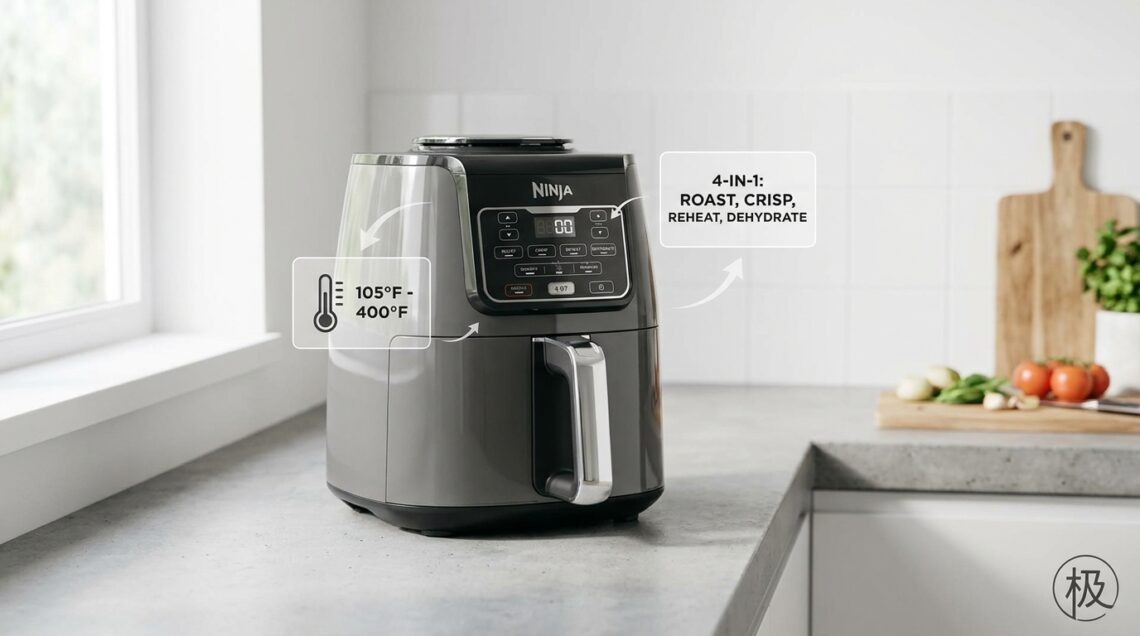
The Ninja model in question operates within a temperature range from 105 degrees Fahrenheit to 400 degrees Fahrenheit. This relatively wide temperature span matters because it determines what types of food preparation tasks the unit can handle. The lower end enables gentle applications like keeping food warm or slow-cooking certain dishes, while the upper range handles the high-heat searing and crisping that air fryers are known for.
Key Features and What They Mean
Four-Quart Capacity
Capacity refers to how much food you can fit in the cooking chamber at one time. A 4-quart air fryer sits in the middle range—larger than the compact 2 to 2.5-quart models you’ll find in kitchens with limited counter space, but smaller than the 6-quart or larger units designed for families or meal-prep scenarios.
Understanding what 4 quarts actually means in practical terms helps set realistic expectations. For most households, this capacity allows you to prepare main dishes for four to six people in a single batch, though the actual serving size depends on what you’re cooking. Denser foods like chicken breasts take up less volume than, say, French fries, so the relationship between quart capacity and food quantity isn’t always straightforward.
Four Cooking Functions: Roasting, Crisping, Reheating, and Dehydrating
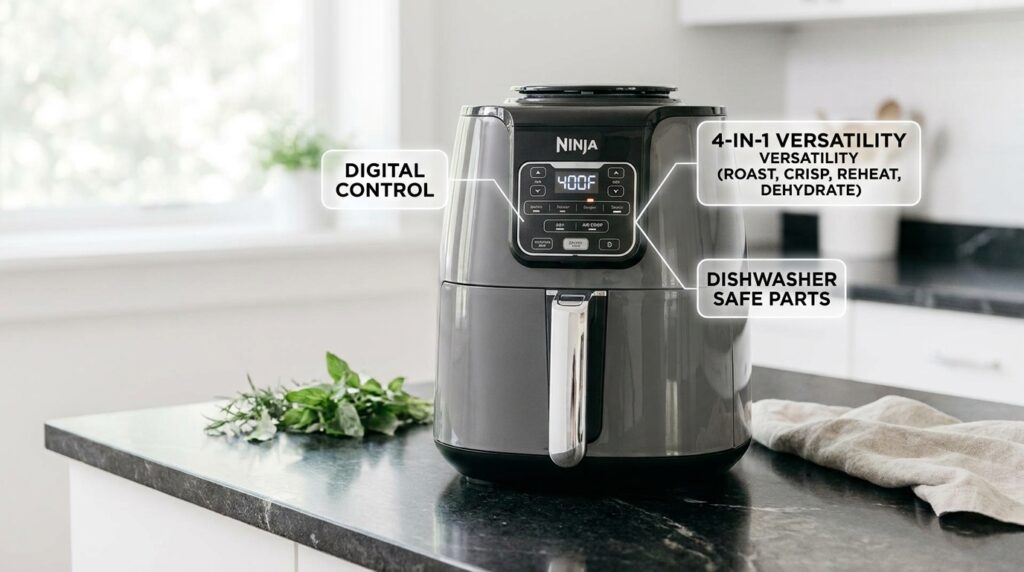
The model combines four distinct cooking modes into a single unit. This multi-function design determines its versatility in the kitchen:
Roasting involves using moderate to high heat to cook food through while developing a flavorful exterior. This applies to everything from chicken and vegetables to potatoes and seafood. Roasting typically occurs around 350 to 400 degrees Fahrenheit.
Crisping pushes air fryer cooking to its signature strength. This function uses high heat and rapid air movement specifically designed to create crispy textures. It’s what people typically think of when they consider air fryer cooking—achieving golden, crunchy exteriors on foods.
Reheating represents a lower-temperature function that warms already-cooked food without drying it out or overcooking the exterior. This matters because a regular oven or microwave approach can sometimes compromise texture or moisture content. A dedicated reheating function suggests the unit has been designed with this practical need in mind.
Dehydrating uses sustained, lower temperatures over extended periods to remove moisture from food. This enables making beef jerky, dried fruit, vegetable chips, and similar shelf-stable foods at home. The dehydrating function typically requires temperatures in the 105 to 160-degree range, which is why the lower temperature limit on this model becomes relevant.
Temperature Range: 105°F to 400°F
The temperature span directly determines cooking versatility. Many air fryers start at 300 or 350 degrees, which limits their usefulness for dehydrating tasks. The inclusion of 105-degree capability opens up dehydrating and gentle warming applications that wouldn’t be possible otherwise.
The 400-degree maximum represents the high end for most home air fryers. Professional kitchen equipment sometimes exceeds this, but for residential cooking, 400 degrees handles virtually all practical applications—from high-heat searing to standard air-frying tasks.
1550-Watt Power
Wattage indicates how much electrical power the appliance draws. Higher wattage generally correlates with faster heating and more consistent temperature maintenance, though actual cooking performance depends on several factors beyond just raw watts. A 1550-watt unit falls in the middle range for air fryers; some models run at 1200 watts while others reach 1800 watts or higher. This wattage level should provide adequate power for the 4-quart capacity without requiring dedicated electrical circuits in most home kitchens.
Dishwasher-Safe Parts
This practical feature addresses a common concern with kitchen appliances—cleanup complexity. Not all air fryer components can safely go in the dishwasher. The fact that this model includes dishwasher-safe parts (likely the basket and tray) means less hand-washing, though you’d want to verify which specific components the manufacturer considers dishwasher-safe before purchase.
Practical Applications and Cooking Scenarios
Understanding what you can actually make with this unit provides clearer insight into whether it fits your cooking patterns.
Everyday Dinner Preparation
The 4-quart capacity handles typical weeknight dinners reasonably well. You can roast a chicken (cut into portions or left whole depending on size) with vegetables in a single batch. Ground meat dishes like meatballs or burger patties work efficiently. Salmon fillets, pork chops, or chicken thighs all cook effectively. The roasting function at around 375 to 400 degrees gets these proteins cooked through while developing flavorful browning on the exterior.
Crispy Sides and Snacks
This is where air fryers shine in most kitchens. French fries, whether from frozen or freshly cut, crisp up in minutes without immersion in oil. Sweet potato fries, vegetable chips, and similar sides cook quickly. The crisping function excels at this because it’s specifically designed for this texture development.
Frozen Food Convenience
Many people use air fryers primarily as a faster alternative to conventional oven reheating of frozen foods. Frozen dumplings, spring rolls, breaded chicken, and similar items cook more quickly in an air fryer than in a conventional oven, and some users report better texture compared to microwaving.
Batch Cooking and Meal Preparation
The 4-quart capacity makes this model suitable for cooking components for multiple meals at once. You might roast several chicken breasts, prepare a large batch of roasted vegetables, or crisp up a quantity of onions for the week. The ability to make multiple batches sequentially means you can build meal components that get used throughout the week.
Reheating Previously Cooked Food
Beyond just convenience, the reheating function addresses a genuine need. Yesterday’s pizza, fried chicken, or roasted vegetables often taste better when reheated in an air fryer rather than a microwave, which can leave foods soggy. The dedicated reheating function suggests the unit manages this better than simply running crisping mode at lower temperatures.
Dehydrating Projects
Creating homemade beef jerky, dried apple slices, vegetable chips, or other dehydrated snacks becomes possible with the lower temperature capability. This transforms the unit from primarily a cooking appliance into something that handles food preservation projects. People interested in making their own trail mix, dog treats, or dried herbs find value in this capability.
Who This Unit Might Suit
Small to Medium-Sized Households
Families of three to five people typically find a 4-quart air fryer practical for most meal scenarios. It’s large enough to handle dinner without multiple batches in many cases, but not so oversized that it takes up excessive counter space.
People With Limited Oven Access
In situations where your conventional oven is unreliable, small, or you’re in temporary housing with limited kitchen equipment, an air fryer can substantially expand cooking possibilities.
Those Interested in Faster Cooking
If reducing cooking time is a priority—whether due to busy schedules or simply preferring quicker meal preparation—air fryers generally accomplish this compared to traditional ovens.
Home Cooks Exploring Reduced-Oil Cooking
Individuals interested in reducing the amount of oil used in their cooking without completely changing their approach to food preparation often find air fryers accommodating.
People Who Appreciate Multifunctional Appliances
If kitchen counter space is at a premium, choosing an appliance that handles roasting, crisping, reheating, and dehydrating reduces the need to own separate equipment for these tasks.
Important Considerations Before Deciding
Size and Counter Space
A 4-quart air fryer isn’t a tiny countertop gadget. It requires dedicated space, and you’ll need room for it to sit during use. Unlike compact 2-quart models that fit easily into a corner, this size demands either permanent counter real estate or regular moving in and out of storage. Consider your actual available space before committing.
Preheating Requirements
Most air fryer cooking involves a preheating step, typically 3 to 5 minutes. If you’re accustomed to simply opening a conventional oven and putting food in, the preheating wait might feel like an extra step in your workflow. This doesn’t make air frying impractical, but it’s worth factoring into your expectations about time savings.
Learning Curve and Recipe Adjustments
Traditional recipes sometimes require modification for air fryer cooking. Food arrangement in the basket affects results—overcrowding prevents proper air circulation. Cooking times may differ from oven or stovetop versions. Expecting flawless results on the first try with unfamiliar foods usually leads to disappointment. Successful air fryer cooking involves learning how your specific unit handles different foods.
Temperature Precision Expectations
While air fryers offer temperature controls, actual cooking results involve variables beyond just temperature. Air fryer design, basket placement, food density, and other factors influence actual cooking outcomes. This unit should provide reasonably consistent results, but expecting absolute precision like in a laboratory setting sets unrealistic expectations.
Noise Level
Air fryers generate noise during operation due to the fan that circulates hot air. This is normal and expected, though specific decibel levels vary between models. If you’re sensitive to appliance noise or live in a situation where noise is a concern, this is worth researching before purchase.
Basket and Interior Coating Durability
Over time, the non-stick coating on air fryer baskets can wear. How well this particular model’s coating stands up to regular use and cleaning (especially in the dishwasher) affects its longevity. Understanding potential maintenance or replacement needs helps inform long-term expectations.
General Comparison of Air Fryer Types
The market includes several different air fryer categories, and understanding how this model fits in provides perspective:
Compact Single-Basket Models (2-2.5 quarts)
These excel in space-constrained kitchens and handle cooking for one to three people effectively. Their smaller size means faster preheating and less counter space required. The tradeoff is limited capacity—you’ll often need multiple batches for larger groups. These units are typically the most affordable option.
Mid-Range Multi-Basket Models (4-5 quarts)
This category, where the Ninja model falls, offers a practical balance. The capacity handles typical household cooking without excessive size. Some models in this range include multiple baskets or compartments that can be used independently, though this adds complexity.
Large Family-Size Models (6+ quarts)
These suit larger households, batch cooking, or commercial use. They require more counter space and sometimes more electrical draw. The larger capacity reduces the need for multiple batches, but they’re generally more expensive and slower to preheat.
Oven-Style Air Fryers
These incorporate a vertical design that mimics conventional toasters or small ovens. Some offer multiple levels or racks for cooking different foods simultaneously. The trade-off is usually higher cost and significant counter space requirements.
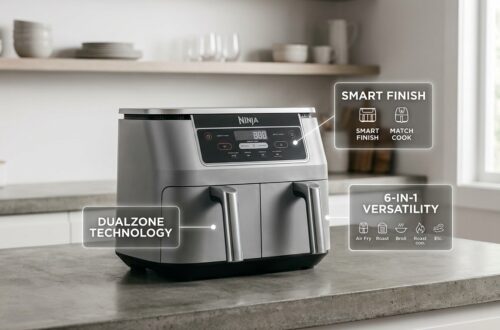
Dual-Basket or Compartment Models
Some units include separate cooking spaces that can operate independently. This allows cooking two different foods at different temperatures simultaneously—useful for certain meal scenarios but adds to the complexity and cost.
The 4-quart single-basket model represents a straightforward, practical choice that prioritizes functionality without adding the complexity of multiple compartments or the space demands of significantly larger units.
Frequently Asked Questions
How does cooking time compare to a conventional oven?
Air frying typically reduces cooking time by approximately 20 to 30 percent compared to traditional oven cooking, though this varies by food type. A chicken breast that might take 20 minutes in a 375-degree oven might take 15 minutes in an air fryer. The preheating time, though relatively short, still factors into the total process time.
Can you use it for everything you’d cook in a regular oven?
Mostly, yes, though some adjustments may be necessary. Baked goods like cookies or cakes sometimes need modification because air circulation differs from oven baking. Foods requiring long, slow cooking (like braised dishes) work differently in an air fryer. Foods that need steam to cook properly (like some dumplings) may need slight technique adjustments. But the majority of roasted, fried, or reheated foods translate well.
Is the air fryer hard to clean?
The dishwasher-safe components simplify cleanup compared to models with limited dishwasher-safe parts. Hand-washing is still straightforward for these parts, especially if you clean them shortly after cooking rather than letting food dry on them. The unit itself doesn’t require internal cleaning beyond occasional wiping of the heating element area.
Will you save money using an air fryer compared to other cooking methods?
Savings depend on your current cooking patterns. If you regularly buy expensive frozen prepared foods or frequently use takeout, an air fryer that enables easier home cooking could reduce food costs. If you already cook efficiently at home, savings are primarily in time rather than money. The electricity cost to operate an air fryer is relatively low compared to most household appliances.
What’s the warranty typically like?
Warranty details vary by retailer and region, so this requires checking specific product information. Most kitchen appliances include at least a one-year manufacturer’s warranty covering defects, though extended warranties may be available through some sellers.
Can you use cooking oils or sprays in an air fryer?
Yes. While air fryers can cook foods without added oil, many people add small amounts to enhance browning or texture. Some foods benefit from a light oil spray. The specific oils that work best in high-heat cooking (like avocado oil or refined coconut oil) are preferable to oils with lower smoke points.
What happens if you overcrowd the basket?
Overcrowding prevents proper air circulation, which impairs the crisp-development that air fryers excel at. Food ends up more steamed than air-fried. Most effective cooking uses a single layer of food with space between pieces, or if stacking is necessary, shaking the basket partway through cooking to ensure all surfaces receive proper air exposure.
Is it worth getting a model with four cooking functions versus one with just crisping and roasting?
The addition of reheating and dehydrating functions broadens the appliance’s usefulness without adding significant cost or complexity. If you regularly reheat leftovers or have interest in making dehydrated snacks, the multi-function design justifies itself. For someone using an air fryer purely for crisping chips and reheating frozen foods, these additional functions matter less, though they’re still convenient when you want them.
Conclusion
The Ninja 4-quart air fryer with its four cooking functions represents a practical mid-range option designed to handle multiple kitchen tasks efficiently. The capacity suits typical household cooking without excessive size, while the temperature range and multiple functions accommodate everything from roasting proteins and vegetables to reheating leftovers and creating dehydrated snacks.
Success with this or any air fryer involves setting realistic expectations about what the technology does—it’s a faster alternative to conventional ovens for many foods, not a miraculous transformation of cooking. Learning how your specific unit handles different foods takes some experimentation, but most people report the process reasonably intuitive once they prepare a few test batches.
The decision to invest in an air fryer ultimately depends on your specific kitchen needs, available space, and cooking patterns. For households that would genuinely benefit from faster cooking of roasted and fried foods, appreciate the ability to reheat without using a microwave, or have interest in dehydrating projects, this model offers the capacity and functionality to make regular use practical.